My name is Michael Carter, and Lily was three years old when her mother Emily died from complications following a sudden illness. There are experiences people tell you will become easier with time, but raising a little girl who keeps asking when Mommy is coming home is not one of them.
For almost two years, Lily and I were a family of two. My parents lived several hours away, Emily’s parents helped whenever they could, and I learned how to brush tangled hair, pack lunches, identify which stuffed rabbit absolutely could not be substituted with another stuffed rabbit, and attend preschool events where almost every other child had two parents sitting in folding chairs.
Lily was not an easy child because no child who loses a parent at three is easy. She had nightmares.
She sometimes panicked when I traveled for work. For several months she became terrified whenever I had a cold because she believed being sick meant dying.
But she was also affectionate, funny, painfully observant, and fiercely protective of people she loved. When I met Vanessa, Lily was five.
Vanessa worked in pharmaceutical sales, had no children of her own, and seemed patient with Lily in a way that initially made me trust her. She never tried to replace Emily.
At least not in the beginning. She told Lily, “You already have a mom.
I just hope someday I can be another person who loves you.” That sentence mattered to me.
We married eighteen months later. Noah was born the following year.
For a while, I genuinely believed we had become the kind of blended family people spend years trying to build. Lily loved Noah from the moment we brought him home.
There are photographs of her sitting beside his bassinet reading picture books to a baby who obviously understood none of them. If he cried, she would run for Vanessa.
When he learned to walk, Lily became his favorite person to chase through the house. She called herself his “big protector.”
That was why Vanessa’s first complaints surprised me. Lily was seven when Vanessa told me she had shoved Noah away from a toy.
I spoke to Lily, who said Noah had grabbed her drawing and she pulled it back too hard. That sounded like children.
I made her apologize for yanking the paper and reminded her to use words. A few weeks later Vanessa said Lily deliberately knocked over Noah’s cup because she was jealous that I had taken him grocery shopping without her.
Lily insisted it had been an accident. Again, nothing seemed extraordinary.
Siblings fight. Children spill things.
Vanessa began keeping what she called a behavior journal. At first I thought it was excessive, but she said Lily’s therapist might eventually need examples if the jealousy became worse.
I should have questioned it then. Instead, I was grateful Vanessa seemed attentive.
My job did not help. I managed regional sales for an industrial equipment company and traveled five or six nights every month.
It was less than before Emily died, but still enough that Vanessa handled many school pickups, dinners, and bedtimes when I was away. Over time, her reports grew more serious.
Lily had supposedly pinched Noah when Vanessa turned around. Lily had hidden his favorite toy.
Lily had whispered that she wished he had never been born. Once Vanessa called me at a hotel and said Lily had locked Noah inside a closet for almost ten minutes.
That frightened me. When I came home, I questioned Lily privately.
She started crying and swore Noah had gone into the closet himself during hide-and-seek. Vanessa said that was exactly what Lily wanted me to believe.
“Michael, she knows you’ll always choose her version because of Emily.” I hated that sentence.
“This has nothing to do with Emily.” Vanessa sighed.
“It has everything to do with Emily. You feel guilty every time you discipline Lily because she lost her mother.”
I became defensive, which made the conversation worse. For the first time, Vanessa said she believed Lily needed “more structure than we could provide at home.”
I rejected the idea immediately. Lily was seven.
She needed family, not removal. Vanessa backed down.
Or I thought she did. Over the next several months, a strange pattern developed.
Vanessa would report serious behavior whenever I was away, but when I was home, Lily and Noah seemed like ordinary siblings. They argued over television shows.
Noah invaded Lily’s room. Lily sometimes bossed him around.
But I never saw the cruelty Vanessa described. I mentioned this once.
Vanessa answered immediately. “Because she’s performing for you.”
That explanation was difficult to disprove. If Lily behaved well, it proved she was manipulative.
If she became upset after being accused, it proved she was unstable. Vanessa had created a system where every possible reaction made Lily look guilty.
I did not recognize that at the time. Worse, I began questioning my daughter more often.
“Did you touch Noah?” “Did you take that?”
“Why did Vanessa say this?” Every time Lily denied something, I studied her face looking for dishonesty.
I did not realize what that was doing to her. She became quieter around me.
When I returned from trips, she stopped running to the door. I assumed she was getting older.
The truth was that she had started believing every homecoming might include another interrogation. Then came the staircase.
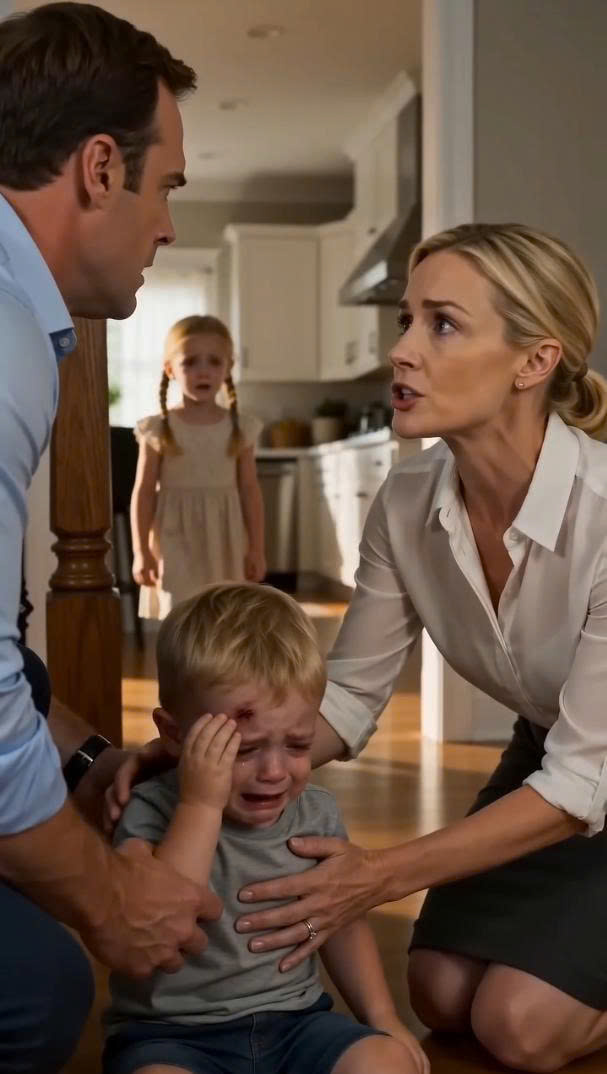
It was a Saturday afternoon. I was in my home office finishing paperwork when I heard a crash followed by Noah screaming.
By the time I reached the foyer, Vanessa was already beside him. Blood was running from a small cut near his eyebrow.
Lily stood near the kitchen entrance holding a glass of water. Vanessa looked directly at me.
“She pushed him.” Lily immediately shouted, “No!”
“Lily,” Vanessa said sharply. “Do not lie.”
“I didn’t touch him!” Noah was crying too hard to explain anything.
My first priority was making sure he was okay. We cleaned the cut and called our pediatrician.
Because he had fallen several steps and hit his head, we were advised to have him evaluated. While I gathered shoes and jackets, Vanessa followed me upstairs.
“This is it, Michael.” “What?”
“You cannot keep pretending nothing is happening.” “I’m not pretending anything.”
“She could have killed him.” I looked toward the stairs.
“We don’t even know exactly what happened.” Vanessa stared at me.
“Your son is bleeding, and you’re still protecting her.” Something about the way she said it stopped me.
Your son. Not Noah.
Not our son. She had turned two children I loved into opposing sides.
Then Lily appeared at the bottom of the hallway. Her whole body was shaking.
“Daddy, check the camera.” I almost forgot it existed.
Months earlier, Noah had started wandering into the hallway at night, so I installed a small camera above the upstairs landing. It captured the top section of the staircase and part of the kitchen entrance below.
Vanessa said, “Michael, we need to leave.” “Thirty seconds.”
I opened the security app. The recording was still there.
At 3:41 p.m., Noah appeared upstairs dragging his stuffed dinosaur behind him. Lily was visible downstairs near the kitchen, pouring water.
Noah stepped onto the first stair. The dinosaur remained behind him.
Its long fabric tail slid beneath his shoe. He slipped.
He reached for the railing, missed it, and tumbled down several steps. Lily dropped her glass and ran toward him after he fell.
She never touched him. Not before.
Not during. Not even remotely.
I replayed the footage. Then I turned toward Vanessa.
“Why did you say she pushed him?” For several seconds she did not answer.
“I thought I saw her.” “From where?”
“The bedroom.” “The bedroom doesn’t have a clear view of the stairs.”
“I heard them arguing.” “The camera has audio.”
She went silent. Lily was watching us.
I replayed the previous minute. There was no argument.
Noah was singing to himself. Lily was downstairs.
Vanessa’s face changed. “Fine.
I was wrong.” “You didn’t say you thought Lily pushed him.
You said she pushed him.” “I panicked.”
“Why?” “Because everything else she’s done has led to this.”
“What everything else?” Vanessa’s expression hardened.
“Do not start rewriting the last year because one incident happened differently.” We took Noah to urgent care.
He needed three stitches but had no serious head injury. During the drive home, I kept thinking about the confidence in Vanessa’s accusation.
She had not checked on where Lily was standing. She had not asked Noah what happened.
She simply saw an injured child and blamed Lily immediately. That night, after both children were asleep, I opened the family laptop.
Vanessa and I used separate email accounts, but her mail remained logged in because she often used the computer to print school forms. I was not looking for an affair.
I was not even sure what I was looking for. I searched Lily’s name.
Hundreds of results appeared. School messages.
Pediatric appointments. Family conversations.
Then I saw one from Westbrook Residential Academy with the subject line: FINAL ARRIVAL CONFIRMATION — LILY CARTER. My hands went cold.
I opened it. “Dear Mrs.
Carter, we look forward to welcoming Lily tomorrow at 2:00 p.m. Our admissions team has reviewed the updated behavioral incident information you provided.”
Tomorrow. I read the sentence repeatedly.
Vanessa had enrolled my daughter in a residential behavioral program without telling me. Attached was a packing list, intake paperwork, consent forms, medical releases, and a twelve-page behavioral history.
I opened the history. Almost every page contained accusations I had never seen.
According to Vanessa, Lily had bitten Noah twice. She had pushed him from playground equipment.
She had threatened to smother him while he slept. She had destroyed family property during “violent rages.”
She had repeatedly said she wanted Noah dead. None of this had ever been reported to me.
Worse, several incidents allegedly happened on dates when I had been home. I knew they were false.
One report claimed Lily locked Noah in a bathroom for forty minutes during my birthday dinner. I remembered that night clearly because Lily had spent most of it helping my mother decorate a cake while Noah fell asleep on my father’s lap.
Another claimed Lily smashed a lamp during a rage on Thanksgiving. The lamp had actually fallen when our dog ran into its cord.
I kept reading. Vanessa had been building a fictional child.
Not Lily as she was, but Lily as Vanessa needed a school to believe she was. Then I found emails between Vanessa and an admissions counselor.
Three months earlier, Vanessa wrote, “My husband is struggling to accept the seriousness because he carries tremendous guilt related to Lily losing her biological mother. I believe once there is an acute safety incident involving our younger child, he will understand residential placement is necessary.”
An acute safety incident. I stared at those words.
Vanessa had been waiting for something. Maybe she had not caused Noah’s fall.
The footage clearly showed she had not been near him. But the moment he fell, she used it exactly as she had predicted.
Her next email, sent less than an hour after the accident, said, “We had another serious event today. Lily caused Noah to fall down the stairs.
We are proceeding with intake tomorrow.” She sent that while we were waiting at urgent care.
She knew the camera existed. She never expected me to check it before agreeing.
I searched more. Upstairs, I found two suitcases inside the guest-room closet.
Lily’s clothes were packed. So were her books, toiletries, several photographs, and the stuffed rabbit she had slept with since she was three.
Vanessa had even packed the framed picture of Emily that normally sat beside Lily’s bed. My daughter appeared behind me in the doorway wearing pajamas.
“Why are my things in there?” I turned around.
I could not lie. “Did Vanessa tell you something about going somewhere?”
Lily’s eyes immediately filled. She nodded.
“What did she say?” “That I might have to live at a school.”
“When?” “A long time ago.”
My stomach dropped. “How long?”
“Before Christmas.” It was April.
“Why didn’t you tell me?” She looked terrified.
“She said you knew.” I crouched in front of her.
“I did not know.” Lily stared at me.
“She said you were deciding.” “Deciding what?”
“If you still wanted me.” I could barely breathe.
“Lily—” “She said if Noah got hurt because of me, you’d finally know I was bad.” Tears rolled down her face.
“She told me you wouldn’t want me anymore if Noah got hurt.” I pulled her against me.
She was shaking. “Listen to me.
Nothing Noah does, nothing you do, nothing anybody says is going to make me stop being your father.” “I didn’t push him.”
“I know.” “Really?”
That word destroyed me. Really.
My daughter needed confirmation that I believed something the camera had proven. I thought about all the times over the previous year I had questioned her.
How many accusations had I treated as evenly balanced conflicts when one adult was manufacturing evidence against a child? “I watched the video,” I said.
“You didn’t touch him.” Lily cried harder, but this time she held onto me.
After she fell asleep, I returned to the laptop. The enrollment agreement listed tuition and residential fees totaling more than $58,000 for the first semester.
A $31,500 deposit had already been paid. I assumed Vanessa had moved money from our joint savings.
She had not. The transfer originated from the Carter Education Trust—Lily’s education fund.
Emily’s parents established that account after Emily died. It contained insurance proceeds and money they contributed over the years specifically for Lily’s future education.
I was the primary trustee until Lily became an adult. Vanessa had no independent authority over it.
But she knew where I kept financial information. Months earlier, during tax preparation, I had given her temporary access to several accounts so she could upload statements for our accountant.
The payment request attached to the enrollment file contained my electronic signature. I had never signed it.
I checked the date. I had been in Dallas for work.
Vanessa had used my stored signature and submitted paperwork certifying that I approved a withdrawal for Lily’s educational expenses. Technically, the money was being sent to a school.
That was how she disguised it. She had taken money meant to build Lily’s future and used it to pay for removing Lily from her present.
At 1:17 in the morning, I called my sister Rebecca. She was an attorney, though family law was not her specialty.
I told her what I had found. Her first words were, “Do not confront Vanessa until you preserve everything.”
I downloaded the emails. I photographed the suitcases.
I saved the camera recording in three locations. I printed the enrollment documents.
Rebecca told me to contact the trust’s financial institution first thing in the morning and ask them to freeze any additional distributions while disputing the unauthorized transaction. She also told me to call an actual family-law attorney before making major decisions involving the children.
“Michael,” she said, “I know you’re angry, but from this point forward, everything needs to be about Lily and Noah, not punishing Vanessa.” She was right.
At six the next morning, Noah wandered into the kitchen with a bandage above his eyebrow. Lily was already sitting at the table.
The moment he saw her, he climbed into her lap. “I fell,” he announced.
Lily nodded. “I know.”
He touched her cheek. “Mommy said you pushed me.”
Lily went still. I knelt beside him.
“Did Lily push you?” Noah shook his head.
“Dino made me fall.” Vanessa entered the kitchen just in time to hear him.
She stopped. “Noah, eat your cereal.”
I looked at her. “We need to talk.”
She glanced toward Lily. “Privately.”
“Rebecca is coming over to take the kids for breakfast.” Her eyes narrowed.
“Why?” “Because we need to talk.”
Twenty minutes later, both children left with my sister. Vanessa stood in the living room with her arms folded.
I placed the Westbrook enrollment agreement on the coffee table. For the first time since I had known her, she seemed unable to manufacture an immediate response.
“You went through my email.” “You enrolled Lily in a residential school.”
“Because you refused to deal with her behavior.” “You forged my signature.”
“I signed for you because you would have delayed again.” “You took thirty-one thousand five hundred dollars from her trust.”
“For her education.” “To remove her from our house.”
Vanessa sat down. “Westbrook is not a prison.
It’s an excellent program.” “She doesn’t need the program.”
“You don’t know that.” I put copies of her behavioral reports beside the agreement.
“You wrote that she bit Noah.” “She has.”
“When?” “I don’t remember the exact date.”
“You gave the school exact dates.” Vanessa’s face tightened.
I pointed to another page. “You said she locked him in a bathroom during my birthday dinner.
She was with my mother most of that evening.” “There were many incidents.”
“You said she threatened to kill him.” Vanessa looked away.
“Children say horrible things when they’re angry.” “Did Lily say that?”
Silence. “Did she?”
“Not those exact words.” I felt something inside me go completely cold.
“How much of this is real?” “Michael, you are obsessed with individual details instead of the overall pattern.”
“Because the details are my daughter’s life.” “Your daughter has controlled this family from the day I entered it.”
There it was. Not concern.
Resentment. “She was five.”
“And everything has always been about what Lily needs. What Lily lost.
What Lily feels. We couldn’t take a vacation without worrying about whether it would remind her of Emily.
We couldn’t change her bedroom. We couldn’t move houses because she had memories there.
Every decision revolved around a dead woman and her daughter.” “Her daughter is also my daughter.”
“Exactly.” Vanessa stood.
“And Noah always comes second.” “Noah does not come second.”
“To you, he does.” “So you decided the answer was sending Lily away?”
“I decided both children deserved stability.” “By lying about one of them?”
Vanessa began crying. “You have no idea what it’s like when you’re gone.
Lily looks at me like I stole her mother’s place.” “Did she say that?”
Vanessa hesitated. “She doesn’t have to.”
“So no.” “Stop doing that.”
“Doing what?” “Making me sound insane because I finally did something you were too guilty to do.”
I stared at her. “You told an eight-year-old I might stop wanting her.”
Vanessa’s expression flickered. “I told her actions have consequences.”
“You told her if Noah got hurt, I would send her away.” “I needed her to understand how serious this was.”
“You made her afraid of her own father.” “Because you undermine me every time she cries.”
“No. Because you needed her scared enough not to tell me what you were planning.”
Vanessa said nothing. I asked one final question.
“When were you going to tell me Westbrook expected her today?” She wiped her face.
“After breakfast.” “Before or after you put her in the car?”
Another silence. Then she said the sentence I would hear in my head for years.
“You weren’t supposed to find out until she was already gone.” I did not yell.
Somehow that made Vanessa more nervous than if I had. I picked up the paperwork.
“You need to stay somewhere else today.” “This is my house too.”
“Then I’m taking Lily somewhere else until lawyers tell us what happens next.” “And Noah?”
“He’s my son too. We are going to work that out legally.”
Vanessa laughed bitterly. “So now you’re going to take both children from me?”
“No. I’m going to make sure no child in this family is used as evidence against the other one.”
By noon, Westbrook knew the enrollment was disputed. The admissions director sounded horrified when I explained that I had never authorized placement and that many behavioral reports appeared false.
The school did not admit Lily. They preserved the application records and later refunded the unused portion of the payment after the financial dispute was resolved.
The trust administrator froze further transactions and began reviewing how the withdrawal had been approved. My attorney advised me to document the forged signature and misrepresentation rather than make accusations I could not prove in court.
That became a theme over the following months: evidence, not rage. The more evidence we gathered, the worse the pattern became.
Vanessa’s behavior journal had two versions. The notebook she occasionally showed me contained vague descriptions—“argument over toy,” “difficult bedtime,” “jealous after Dad called.”
The reports sent to Westbrook transformed those ordinary events into violence. A toy argument became “Lily shoved Noah against furniture.”
A difficult bedtime became “forty-minute destructive rage.” Being sad after I ended a business-trip video call became “obsessive attachment to father and hostility toward sibling.”
Vanessa had even contacted Lily’s school counselor without telling me and asked whether the school had noticed aggression. The counselor repeatedly responded that Lily was generally cooperative, socially appropriate, and showed no serious behavioral concerns.
Vanessa did not forward those replies to Westbrook. Instead she wrote that Lily “masks effectively in public settings.”
Just like at home, every piece of evidence against Vanessa’s theory became evidence supporting it. Lily eventually told her therapist something that explained why she had become so quiet around me.
Vanessa had been coaching her before my trips ended. “Daddy is tired when he comes home,” she would say.
“If you cause problems, he’ll think traveling is easier than being here.” Another time: “Your dad finally has a happy family again.
Don’t ruin it because you’re jealous.” Lily did what frightened children often do.
She tried to become smaller. She stopped complaining.
She stopped asking me to intervene. She apologized constantly.
If Noah bumped into her, she said sorry. If Vanessa forgot something, Lily assumed it was somehow her fault.
I had mistaken obedience for maturity. That realization hurt almost as much as discovering the school.
Noah had been affected too. Vanessa repeatedly asked him leading questions after ordinary sibling conflicts.
“Did Lily hurt you?” “Was Lily being mean?”
“Did Lily make you fall?” Four-year-olds want to give adults the answer that makes them happy.
Fortunately, in the staircase incident, he consistently remembered the dinosaur beneath his shoe. During one child-specialist interview he said, “Mommy said Lily did it, but Lily was downstairs.”
I did not celebrate that. No child should have to correct one parent to protect another child.
The divorce moved forward. Vanessa’s attorney initially argued that I was exploiting one mistaken accusation to destroy the marriage.
Then they saw the emails, the packed suitcases, the false reports, and the trust withdrawal. Their strategy changed.
Vanessa began describing herself as an overwhelmed stepparent who had made increasingly poor decisions because I traveled too much and left her responsible for a traumatized child. There was truth inside that explanation.
I did travel too much. I had accepted Vanessa’s version of events too easily because investigating every conflict felt exhausting.
I had missed warning signs. I admitted that in counseling and in court-related evaluations.
But being overwhelmed did not explain fabricating violent incidents, secretly arranging residential placement, forging my approval, or telling an eight-year-old her father might stop loving her. Eventually, temporary parenting orders gave me primary care of both children while the case was reviewed, with Vanessa receiving structured time with Noah.
She had no parental rights to Lily independent of our marriage, and after what had happened, Lily wanted no contact with her. I did not force it.
Noah’s relationship with his mother was more complicated. He loved Vanessa.
Vanessa loved him. The fact that she had harmed Lily emotionally did not erase their bond, and the professionals involved focused on creating safe boundaries rather than pretending one dramatic courtroom decision could resolve everything.
Vanessa began therapy and parenting counseling. Over time, her time with Noah increased under conditions established through the family case.
Lily remained outside those visits. The financial issue resolved separately.
Investigators determined the education-trust payment had been approved based on documents containing my electronic signature and inaccurate certification that I had authorized the expense. Westbrook returned the refundable balance.
As part of our divorce settlement, Vanessa became responsible for replacing the remaining money lost through fees and nonrefundable costs. Her access to every account related to Lily was permanently removed.
Lily’s maternal grandparents were added as successor trustees alongside me so no one person could quietly make a major decision about the account again. When Emily’s father learned why the money had been withdrawn, he sat at my kitchen table and cried.
“Emily put everything she could into making sure Lily would have choices,” he said. “And somebody used it to take her choices away.”
I had no answer. The hardest conversation came with Lily.
One evening about two months after the staircase incident, I found her sitting on her bed beside the suitcase Vanessa had packed. We had unpacked the clothes, but Lily insisted on keeping the suitcase in her closet.
“Why do you still have that?” I asked.
She shrugged. “Just in case.”
“In case of what?” “In case I have to go.”
I sat beside her. “You are not going to Westbrook.”
“I know.” “Then why would you have to go?”
She picked at a loose thread on the blanket. “If I do something really bad.”
“What is really bad?” “If Noah gets hurt.”
“Noah will get hurt sometimes. He’s four.
Yesterday he ran into the refrigerator.” Lily smiled slightly.
Then it disappeared. “What if it’s my fault?”
I thought carefully before answering. “If you ever hurt Noah on purpose, we would deal with what happened.
There would be consequences. We would talk to people who could help.
But consequences do not mean I stop being your father. You do not lose your family because you make a mistake.”
“Even a big one?” “Even a big one.”
She looked at me for a long time. “Vanessa said you picked Noah because he still has a mom and dad.”
I had to look away for a second. “Vanessa was wrong.”
“Did you almost believe her about the stairs?” Children have a frightening ability to ask the exact question adults wish they could avoid.
I could have lied. I didn’t.
“For a few seconds, yes.” Lily’s eyes dropped.
“But then I checked.” “Because I told you?”
“Because you deserved the truth.” “What about the other times?”
I swallowed. “I should have checked more carefully then too.”
“So you didn’t believe me.” “Sometimes I wasn’t sure.
And I’m sorry.” I expected anger.
Instead Lily leaned against me. “I was scared you’d get mad if I kept saying Vanessa lied.”
“You can tell me when an adult lies.” “Even a mom?”
“Even me.” She looked up.
“You’re a dad.” I laughed for the first time that day.
“Especially me.” That conversation changed the way I parented.
I stopped thinking that protecting my children meant always having the right answer. Sometimes it meant creating a home where they could safely tell me I was wrong.
I changed positions at work six months later. It meant giving up a promotion and some money, but the new role involved almost no overnight travel.
I refuse to turn that into a heroic sacrifice. I should have changed earlier.
I had told myself I traveled to provide for my family while failing to notice that one member of my family had become afraid every time I left. Lily gradually became herself again.
Her teacher told me she had started raising her hand more in class. She invited friends home.
She stopped automatically apologizing when Noah cried. The first time they had a real sibling argument after everything happened, Noah grabbed a marker from her desk and Lily shouted, “Give it back!”
I nearly smiled. Her therapist later told me that appropriate anger can be a sign a child finally feels safe enough to stop disappearing.
Noah recovered quickly from his fall. The scar above his eyebrow became a thin white line he proudly called his “dinosaur battle mark.”
He never remembered the staircase as the event that nearly broke our family. Maybe that was a blessing.
About a year after the divorce began, I received an envelope forwarded by my attorney. It was from Vanessa.
She wrote that therapy had forced her to confront something she had spent years refusing to admit. She had resented Lily almost from the beginning—not because Lily was cruel, but because Lily represented a part of my life Vanessa could never fully own.
Emily’s photograph remained in our house. Emily’s parents remained family.
Lily had memories and traditions that existed before Vanessa. After Noah was born, Vanessa became increasingly convinced that the only way to create “our real family” was to reduce the influence of the family that came before her.
She started interpreting normal childhood behavior as evidence Lily was damaged. Once she decided Lily was dangerous, every ordinary conflict confirmed what she wanted to believe.
“I told myself residential school would help her,” Vanessa wrote. “The truth is that I wanted her somewhere else, and I built a version of Lily that justified wanting that.”
She apologized for the trust money, the reports, and what she told Lily about me. She did not ask me to forgive her.
I appreciated that. I never showed the letter to Lily.
At eight years old, she did not need to carry an adult’s confession. Maybe she will read it when she is older.
Maybe she never will. That choice can be hers.
Two years after the night Noah fell, Lily and I visited a college campus with Emily’s parents because their older granddaughter was graduating. Lily was ten by then.
We walked past dormitories, libraries, and students sitting under trees with laptops. Lily pointed toward one of the residence halls.
“Is that like the school Vanessa wanted me to go to?” I said, “Not really.”
“People sleep there.” “They do.”
“Would my trust pay for that?” I smiled.
“Someday, if you choose a college and want to live there, that is exactly the kind of thing the trust can help with.” “But I choose?”
“You choose.” She thought about that, then nodded.
“Okay.” It was such a small conversation, but I understood what it meant.
Money that had once been used to take away her choices was hers again for the future she would choose herself. That night, I found the old Westbrook suitcase in the garage.
Lily had finally removed it from her closet months earlier. I carried it downstairs and asked what she wanted to do with it.
She studied it for a moment. “Can we donate it?”
“Sure.” “To somebody who wants to go somewhere.”
I smiled. “That sounds fair.”
We filled it with clothes she had outgrown and dropped it at a local charity the following weekend. I watched her walk back toward the car holding Noah’s hand, both of them arguing about who got to choose the music.
That was the family Vanessa had claimed could not exist while Lily lived with us. Not perfect.
Not quiet. Not free of jealousy, grief, spilled drinks, slammed doors, or sibling fights.
Just real. Vanessa’s plan failed because one camera proved one accusation false.
But the camera did something more important than clearing Lily of pushing Noah. It forced me to finally ask whether I had been treating my daughter’s innocence as something she had to prove instead of something an adult accusation had to disprove.
Vanessa had spent months preparing to send Lily away. She had written the reports.
Packed the bags. Paid the tuition.
Taken money from Lily’s own education trust. And she had convinced an eight-year-old girl that if one more bad thing happened, her father would stop wanting her.
Vanessa was wrong about one thing. When Noah fell down those stairs, I did panic.
But instead of sending my daughter away, I checked the evidence. And once I saw the truth, the person who lost her place in our home was never Lily.